
Cut Audit Prep Time: GCLP for Trial Lab Managers with Integrated Dx

Good Clinical Laboratory Practice (GCLP) compliance means running a laboratory quality management system (QMS) that stays audit-ready every day, not just when a sponsor calls ahead. The concrete goal is a documented system where every result traces back to a validated method, a chain-of-custody record, and raw data that can be reconstructed on demand. WHO-TDR’s GCLP guidance, NIAID/DAIDS materials, and BARQA frameworks all converge on this same operational standard.
TL;DR:
- A GCLP-compliant QMS relies on continuous records of personnel training, equipment qualification, and method validation, with a focus on traceability and data integrity.
- Implementation requires conducting sponsor-specific gap analyses, establishing a centralized SOP management system, and integrating electronic data systems with enforced audit trails.
- Labs must differentiate GCLP from CLIA, GLP, and GCP by maintaining detailed chain-of-custody, validation, and sample retention records tailored to trial-specific needs.
- Regular internal mock audits, ongoing staff competency assessments, and comprehensive audit packs are essential for maintaining readiness and addressing common deficiencies like outdated training and calibration gaps.
- Consolidating vendors and utilizing AI-driven data checks can streamline data collection, reduce discrepancies, and accelerate GCLP compliance for multi-site and complex trial environments.
What Is GCLP and Why Do Labs Adopt It?
GCLP exists because clinical trial samples sit in an odd gap. They’re not the animal-study specimens that 21 CFR Part 58’s Good Laboratory Practice rules were written for, and they’re not routine patient samples covered by standard diagnostic testing rules either. They come from human trial subjects, carry sponsor-level scrutiny, and need to hold up to regulatory review years after the assay ran.
GCLP is best understood as a hybrid standard. It borrows GLP’s obsession with data integrity, calibration, and documented method validation, then layers on GCP’s insistence on subject protection and unbroken sample traceability. A lab that only does one half of that job, tight assay work with no chain-of-custody discipline, or careful sample logs with no method validation records, will fail a sponsor audit even if its test results are accurate.
Three groups adopt GCLP most consistently:
- Central and bioanalytical labs running pharmacokinetic, immunogenicity, or biomarker assays for multi-site trials.
- Biomarker and specialty labs supporting oncology, infectious disease, and vaccine trials where sponsors need reconstructable data years later.
- CRO-affiliated and academic trial labs operating under NIH, NIAID, or pharmaceutical sponsor oversight.
Guidance comes from a few recognized sources: the WHO-TDR GCLP document, BARQA’s systems-based approach, and NIAID/DAIDS’s more compliance-focused checklists. None of these carries the force of a single global certification. Instead, compliance is typically demonstrated through a documented QMS that sponsors evaluate during their own audit cycles, which is exactly why labs need to build evidence continuously rather than scramble before an inspection.
Core GCLP Elements Your QMS Must Cover
A GCLP-compliant QMS isn’t one document. It’s a set of interlocking programs, each with its own records, that together prove a lab can produce and defend trial-grade data. Auditors move through these in roughly the same order every time.
- Organization and personnel. Every staff member touching trial samples needs a current job description, a training file, and documented competency assessment tied to the specific tasks they perform.
- SOP library and document control. Standard operating procedures need version control, a defined approval workflow, and a historical file so an auditor can see exactly which SOP version was active when any given sample was processed.
- Equipment qualification and maintenance. Instruments critical to trial results need installation, operational, and performance qualification (IQ/OQ/PQ) on file, backed by preventive maintenance logs and calibration records.
- Method validation. Bioanalytical and PK assays need documented validation or verification evidence, ideally aligned with ICH Q2 principles for accuracy, precision, and specificity.
- Sample handling and chain-of-custody. Acceptance criteria, labeling standards, storage conditions, and transport logs need to connect without gaps from collection to final result.
- Independent quality assurance. A QA function separate from the testing staff needs to run internal audits, track corrective and preventive actions (CAPA), and feed findings into management review.
- External quality assurance. Participation in proficiency testing schemes relevant to the trial’s analytes gives sponsors independent proof that a lab’s results are reliable.
Some of these elements deserve more attention than others because they’re where audits actually stall:
- Missing or outdated training records are consistently among the top findings sponsors flag.
- Calibration gaps on secondary or backup instruments get missed more often than primary equipment.
- Method validation for modified or “in-house” assays often lacks the documented rationale an auditor expects to see.
- Sample chain-of-custody breaks most often during courier handoffs or freezer-to-freezer transfers between departments.
Pro Tip: Build your training matrix as a living document tied directly to each SOP version, not a static spreadsheet updated once a year. When an SOP changes, the matrix should automatically flag which staff need retraining before they can run that test again.
Method validation deserves a specific note. GCLP doesn’t demand full validation for every assay the way a drug approval package would, but it does require documented justification for whichever approach a lab takes, full validation, partial validation, or verification against a previously validated method. Sponsors reviewing a bioanalytical plan will ask for that rationale directly, so it needs to live in the analytical plan itself, not scattered across email threads.
How GCLP Differs From GLP, CLIA, and GCP
Confusing these four frameworks is one of the most common ways labs get blindsided during a sponsor audit. Each governs a different piece of the trial puzzle, and none of them substitutes fully for GCLP.
- GLP (21 CFR Part 58) governs nonclinical, animal-based safety studies. It’s rigorous on data integrity but was never built for human subject samples or trial-specific traceability.
- GCLP takes GLP’s data discipline and applies it to human trial samples, adding the chain-of-custody and subject-protection layer GLP doesn’t need.
- CLIA governs routine clinical diagnostic testing in the United States and is genuinely useful for baseline lab quality. It doesn’t, however, require the sample-to-subject reconstruction or sponsor-specific documentation that trial work demands. Labs relying on CLIA certification alone often assume they’re covered for trial work when they’re not; a closer look at CLIA-certified laboratory requirements makes the gap clear.
- GCP (ICH E6) governs how the trial itself is conducted, informed consent, protocol adherence, investigator responsibilities. It says almost nothing about how a lab should validate an assay or calibrate an instrument. GCLP fills that specific gap for lab operations supporting the trial.
For auditors, this means checking four different document trails instead of one. A lab that shows only its CLIA certificate when a sponsor asks for GCLP evidence will get a finding, not a pass, because the sponsor’s checklist is looking for chain-of-custody logs and method validation files that CLIA doesn’t require.
Step-by-Step Implementation Checklist for GCLP Readiness
Getting a working lab from “mostly compliant” to genuinely audit-ready follows a fairly predictable sequence. Skipping steps almost always shows up later as a sponsor finding.
-
Run a sponsor-focused gap analysis first. Before touching any SOP, request the sponsor’s master audit plan or checklist if one exists. Sponsor expectations vary significantly between programs, and mapping your existing processes against the actual criteria a sponsor will use saves months compared to chasing a generic accreditation standard that may not match what your specific sponsor checks.
-
Assign a document-control owner and build an SOP remediation plan. Someone needs to own the SOP library end to end, tracking which procedures are current, which are under revision, and which need retirement. Without a single owner, version control quietly falls apart within a year.
-
Prioritize IQ/OQ/PQ on critical instruments. Not every piece of equipment needs the same urgency. Rank instruments by their impact on reportable trial results and clear the qualification backlog for the highest-risk ones first. Validate methods against ICH Q2(R1) principles where the assay type calls for it.
-
Implement or validate a LIMS with enforced audit trails. A laboratory information management system built for GCLP needs forced audit trails on any data change, role-based access that limits who can edit versus who can only view, and validated change control. The end goal is the ability to pull a contiguous raw-data bundle for any single reported result, from sample receipt through final report, without gaps.
-
Stand up the QA function properly. This means a defined internal audit calendar (not “as needed”), a working CAPA process with tracked closure dates, and a management review cadence where leadership actually sees audit findings and signs off on remediation.
-
Enroll in proficiency testing relevant to your protocol’s analytes. External quality assurance participation gives sponsors independent confirmation of your results, and enrollment lead times can run months, so this step needs to start early, not right before a sponsor visit.
-
Run internal mock audits and assemble the audit pack. Before any external audit, walk through your own checklist as if you were the sponsor. Pull together the training matrix, historical SOP versions, calibration logs, and raw data bundles into one indexed package.
Pro Tip: Treat your mock audit results the same way you’d treat a real finding. If your internal review turns up a gap, open a CAPA for it immediately rather than quietly fixing it and moving on. Sponsors sometimes ask to see your internal audit history, and a clean record with no findings looks less credible than one showing you catch and correct your own problems.
Timelines vary by lab size and existing infrastructure, but a realistic sequence for a lab starting from a partial system typically runs three to six months for SOP remediation and equipment qualification, with LIMS validation and proficiency testing enrollment running in parallel. Labs that try to compress this into weeks almost always end up with paperwork that looks complete but doesn’t reflect what staff actually do, which is worse than an honest gap because it erodes sponsor trust once discovered.
For multi-site programs, standardizing these steps across locations adds another layer of complexity worth planning for early; platform-level governance approaches can keep SOPs and training records aligned across sites instead of drifting apart site by site.
What Auditors and Sponsors Actually Check
Sponsor audits and internal reviews both work through the same broad categories, just with different depth. Knowing the categories in advance turns an audit from a stressful surprise into a routine walkthrough.
- QMS structure: Is there a documented quality manual, and does it map to actual practice?
- Personnel records: Are training files current and tied to specific competencies?
- SOPs: Are current versions in use, with a defensible historical file for prior versions?
- Equipment: Are calibration and maintenance logs complete for every instrument used in reportable results?
- Methods: Is there validation or verification documentation for every assay run?
- Sample management: Does chain-of-custody hold without gaps from collection to disposal?
- Data integrity: Can any single result be reconstructed from raw data through final report?
Building an audit pack around these seven categories, indexed so any document can be pulled within minutes, is the single biggest time-saver during an actual inspection. Insights on audit preparation confirm what most labs learn the hard way: audits are sponsor-driven, and frequency depends heavily on the protocol and the sponsor’s own risk assessment, not a fixed regulatory schedule.
Independent, non-sponsor audits (internal QA reviews, or third-party assessments a lab commissions on its own) tend to run more frequently, often annually, and serve as the dress rehearsal for the less predictable sponsor visits.
Pro Tip: Keep a running “findings log” across every audit, sponsor or internal, going back at least two years. Recurring findings in the same category are the clearest signal to a sponsor that your CAPA process isn’t actually closing the loop.
The most common findings labs run into are strikingly consistent: incomplete training records for staff who joined mid-trial, calibration gaps on secondary equipment, and undocumented deviations that got fixed informally instead of through a logged CAPA. Each of these is fixable within a single remediation cycle if caught early, but each one is also a red flag if a sponsor finds it first.
Records, Data Integrity, and Retention Requirements
Raw data under GCLP has to meet a specific standard, sometimes summarized as ALCOA: attributable, legible, contemporaneous, original, and accurate. Every entry, whether handwritten or electronic, needs to trace back to who recorded it and when, without alteration that isn’t logged.
Retention periods aren’t fixed by a single universal rule. They’re set by protocol requirements, sponsor contracts, and applicable regulatory frameworks, which means a lab needs to check retention obligations per protocol rather than applying one blanket policy across every trial. WHO-TDR’s guidance specifically calls out analytical plans, raw data, audit records, personnel training files, equipment maintenance logs, and SOP historical files as retained records, and secure physical or electronic archives should be used once active retention windows close.
For electronic systems, three things matter most:
- Validation: the LIMS or electronic data capture system needs documented validation before it goes live, not after the first trial runs through it.
- Backups and access control: role-based permissions and regular backups protect against both accidental loss and unauthorized edits.
- Change-control logs: every modification to an electronic record needs a timestamp, a user ID, and, where required, a documented reason for the change. Documenting the reason behind any audit trail change is one of the most frequently overlooked details in electronic systems.
Physical samples carry their own archival considerations. Long-term storage needs documented temperature monitoring, a clear chain-of-custody for any transfer between facilities, and a retrieval process fast enough to support reanalysis if a sponsor or regulator requests it years later. Sample labeling standards that stay consistent from initial collection through long-term storage make that later retrieval far less error-prone.
Common Pitfalls and How to Fix Them
Most GCLP failures aren’t dramatic. They’re small, repeated gaps that compound over a trial’s lifespan.
- Treating GCLP as a paperwork exercise. Compliance documents that don’t reflect actual daily workflow fall apart the moment an auditor asks staff to walk through a process live.
- Assuming CLIA coverage is enough. CLIA certification proves diagnostic testing quality but doesn’t add the trial-specific traceability GCLP requires, so trial samples need chain-of-custody controls layered on top.
- Letting training records go stale. Competency assessments tied to specific SOP versions need refreshing every time the SOP changes, not on an annual calendar regardless of what changed.
- Skipping change control on minor deviations. A “small” undocumented fix to a process is exactly the kind of finding that erodes sponsor confidence, because it suggests bigger issues might go undocumented too.
The fix for most of these is the same: risk-based prioritization instead of trying to perfect everything at once, an annual mock audit that treats findings as real CAPAs, and a habit of closing out corrective actions with a documented verification step rather than marking them “resolved” and moving on.
Pro Tip: Schedule your CAPA closure audits separately from your general internal audit. A CAPA that gets closed without independent verification is one of the most common reasons the same finding reappears in a sponsor’s next visit.
How Integrated Diagnostics Speed Up GCLP Readiness
Fragmented vendor relationships create most of the friction labs experience during GCLP remediation. Every additional vendor for labs, radiology, or specialty testing means another SOP to reconcile, another chain-of-custody handoff to document, and another data format to normalize before an audit pack comes together.
Consolidating those functions under a single contract changes the equation. When labs, radiology, and data delivery run through one integrated relationship, SOP alignment across those services becomes far simpler because there’s one set of procedures to validate instead of three or four vendor-specific versions that need reconciling every time a sponsor asks for consistency.
AI-driven data quality checks add a second layer of speed. Flagging deviations automatically, out-of-range values, missing fields, inconsistent timestamps, as data comes in means corrective workflows start immediately instead of after a manual review weeks later. That earlier catch directly shortens the CAPA cycle auditors care about.
- Single-contract diagnostics reduce the number of vendor SOPs a lab needs to align and audit separately.
- AI-driven checks catch data deviations closer to the point of collection, speeding up correction before results reach a sponsor’s reviewers.
- Standardized, consolidated audit packs across lab and radiology data cut the time sponsors spend requesting missing pieces.
Pro Tip: When evaluating a diagnostics partner for trial support, ask specifically how they consolidate audit evidence across lab and imaging data. A partner who can hand you one indexed package instead of two separate vendor reports saves real time during sponsor review.
Risk Management and Deviation Handling in GCLP Environments
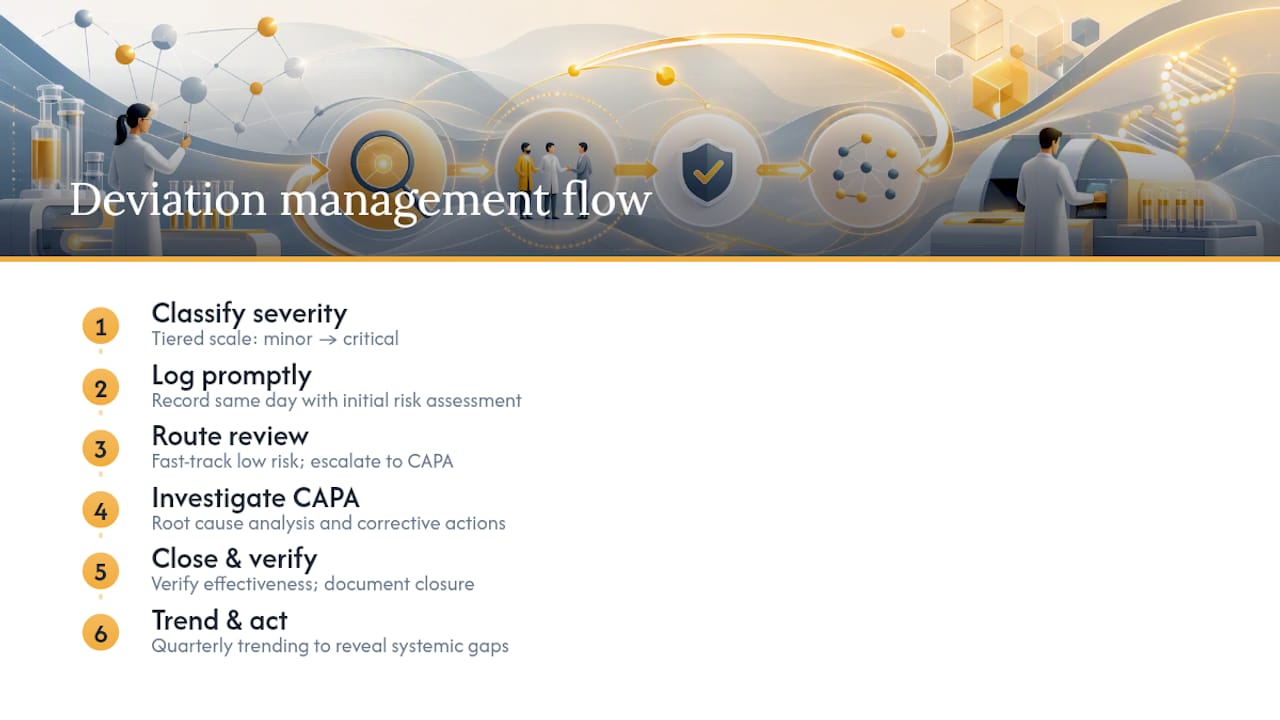
Deviations are inevitable in any lab running trial samples over months or years. What separates a compliant lab from a vulnerable one is how quickly a deviation gets documented, assessed, and closed, not whether deviations happen at all.
A working risk management approach starts with classification. Not every deviation carries the same weight: a minor temperature excursion during short-term storage is a different risk tier than a chain-of-custody gap that breaks sample traceability entirely. Labs that build a tiered severity scale into their deviation process can route low-risk issues through a fast-track review while reserving full CAPA investigations for anything touching data integrity or subject safety.
Timeliness matters as much as classification. A deviation logged the same day it’s discovered, with an initial risk assessment attached, gives QA time to investigate root cause before the next sample batch runs through the same process. Deviations discovered weeks later, often during a routine review rather than in real time, are a recurring theme in sponsor audit findings.
The most durable risk management programs treat every closed CAPA as a data point, not a closed file. Trending deviation types across quarters reveals whether a “one-off” issue is actually a systemic gap in training, equipment, or an SOP that needs rewriting rather than repeated case-by-case fixes.
Why GCLP Compliance Determines Trial Data Reliability
Trial results are only as trustworthy as the process that generated them, and GCLP compliance is the mechanism that makes that process verifiable rather than assumed. A validated method run on a calibrated instrument by a competent, trained analyst, with an unbroken chain-of-custody back to the subject, is what allows a regulator to accept a result without independently repeating the work.
The reliability payoff shows up most clearly during data reconstruction. When a regulator or sponsor questions a specific result years after a trial closes, a GCLP-compliant lab can pull the full raw-data bundle, method validation record, and chain-of-custody trail in a matter of hours. A lab without that discipline may not be able to answer the question at all, which puts the entire dataset’s credibility at risk, not just the one flagged result.
This is also where GCLP protects against a quieter risk: silent data drift. Without documented equipment qualification and method validation, a gradual instrument shift or reagent lot change can skew results without anyone noticing until an external proficiency test flags the discrepancy. GCLP’s structure, calibration schedules, validation checkpoints, external QA participation, catches that drift before it contaminates months of trial data.
Sponsors increasingly treat GCLP compliance itself as a proxy for data quality when selecting lab partners, which means the compliance program isn’t just a regulatory checkbox. It’s a direct input into whether a trial’s dataset holds up under scrutiny during submission review.
Training Requirements and Competency Assessment Under GCLP
Training records are one of the most frequently cited findings in sponsor audits, and the reason is almost always the same: training happened, but competency was never formally assessed afterward.
GCLP expects a two-part process for every staff member touching trial samples. First, documented training on the specific SOP or task, delivered by someone qualified to train it. Second, a competency assessment that proves the training worked, direct observation, a practical test, or a documented review of initial work output before that person is cleared to perform the task independently.
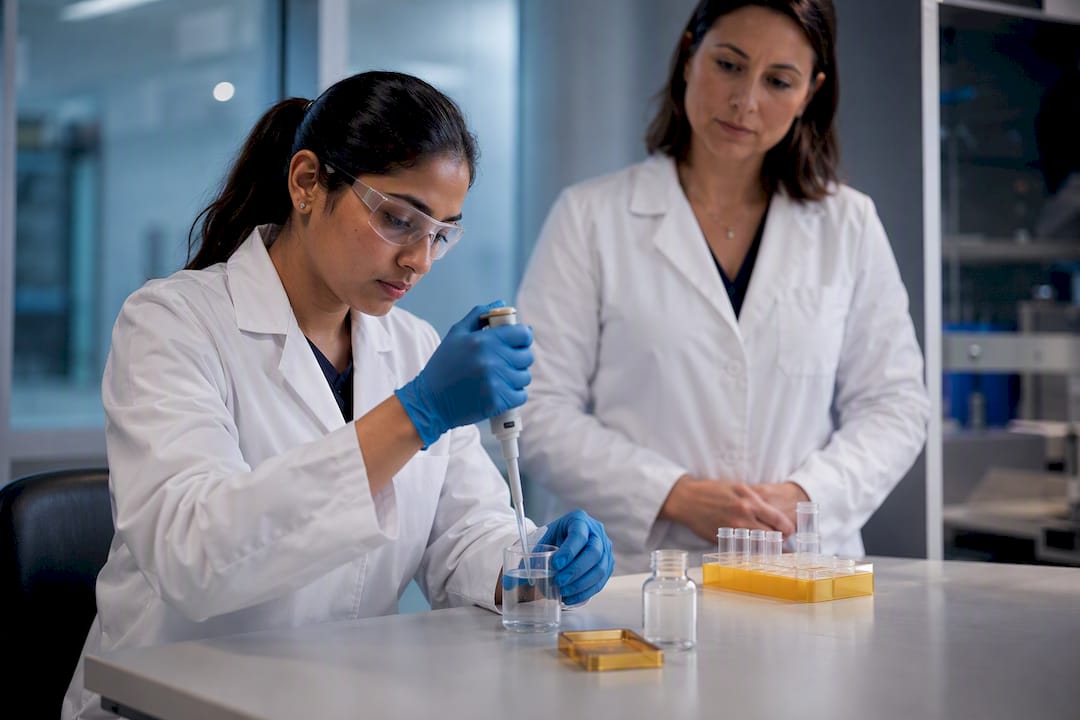
Competency assessment needs to be role-specific and task-specific rather than generic. A phlebotomist competent in venous draws isn’t automatically competent in a new sample stabilization protocol just because they’ve worked in the lab for years. Each new SOP or SOP revision should trigger a fresh competency check for anyone whose work touches that procedure.
Ongoing assessment matters as much as initial certification. Annual or periodic re-assessment, especially for high-risk or infrequently performed procedures, catches skill decay before it shows up as a data quality issue. Labs that skip this step often discover the gap only when a sponsor audit asks for evidence of recent competency, not just the original training date from years earlier.
The training matrix itself should function as a live compliance tool, linked directly to current SOP versions, so anyone reviewing it can instantly see whether a staff member’s certifications match what they’re currently authorized to perform.
Treat GCLP as Continuous Governance, Not a Checklist
The biggest misconception about GCLP compliance is thinking of it as a state you reach and then maintain passively. It isn’t. The labs that handle sponsor audits with the least drama are the ones that never stopped generating audit evidence in the first place, because it was baked into daily workflow rather than assembled reactively before a visit.
That means investing in systems, a validated LIMS, a training matrix tied to live SOP versions, a CAPA process that actually closes, that make evidence retrieval a five-minute task instead of a two-week scramble. It also means engaging sponsors early enough to understand their specific audit criteria before assuming a generic accreditation approach will satisfy them. Sponsor expectations differ enough between programs that a one-size-fits-all posture often wastes effort on the wrong priorities.
The labs that struggle most under GCLP aren’t usually the ones with bad science. They’re the ones whose documentation can’t keep pace with their science, where good work gets undermined by an incomplete training file or a calibration log with an unexplained gap. Fixing that gap isn’t glamorous work, but it’s the difference between data that survives scrutiny and data that doesn’t.
— Kohealth Labs
Get Support for GCLP Readiness and Ongoing Compliance
Coordinating GCLP readiness across separate lab, imaging, and data vendors multiplies the SOP reconciliation work described throughout this guide, every additional vendor contract means another set of procedures to align before an audit pack comes together cleanly. Consolidating laboratory diagnostics, radiology, and analysis-ready data delivery under a single contract can reduce vendor handoffs that typically slow down GCLP remediation timelines.

That integration extends into the data layer itself. Kohealth Labs applies AI-driven quality checks that flag deviations across biomarker, genomic, and imaging results as they come in, giving quality teams a head start on corrective workflows instead of discovering issues during a post-hoc review. Test panels spanning many biomarkers, paired with onboarding and training support, can help reduce the need to reconcile multiple vendor formats into one audit pack.
If your lab is preparing for a sponsor audit or building out GCLP infrastructure for a new trial, Kohealth Labs’ integrated diagnostics offering is a practical next step to request a readiness consultation and see how a single-contract model maps against your current sponsor requirements.
Authoritative Guidance and Primary Sources
- Good Clinical Laboratory Practice (GCLP) — WHO/TDR, the primary GCLP framework document.
- Guidelines on Good Clinical Laboratory Practice — PMC, a peer-reviewed overview of core GCLP elements.
- Evaluation and Recommendations on Good Clinical Laboratory Practice — PLOS Medicine, comparing BARQA and NIAID/DAIDS approaches.
- Good Clinical Laboratory Practice (GCLP) — CASRAI, a concise definitional reference.
This article is general information, not a substitute for advice from a qualified doctor. Consult a qualified healthcare professional about your own circumstances before acting on anything here.
Sources
- Good Clinical Laboratory Practice (GCLP) — WHO/TDR
- Guidelines on Good Clinical Laboratory Practice — PMC
- Evaluation and Recommendations on Good Clinical Laboratory Practice — PLOS Medicine
FAQ
What Are GCLP Guidelines?
GCLP guidelines are the documented systems and procedures, personnel training, SOPs, equipment qualification, quality assurance, and record retention, that a lab follows to make trial data reconstructable and defensible to sponsors and regulators. The WHO-TDR document is the most widely referenced version of these guidelines.
What Is the Difference Between GLP and GCLP?
GLP governs nonclinical, animal-based safety studies under 21 CFR Part 58, while GCLP applies that same data-integrity discipline to human clinical trial samples and adds GCP-style subject traceability and chain-of-custody requirements that GLP doesn’t need.
What Does GCLP Mean?
GCLP stands for Good Clinical Laboratory Practice, a hybrid quality standard combining GLP-grade data integrity with GCP-grade sample traceability for laboratories analyzing human clinical trial specimens.
What Does It Mean to Be GLP Compliant?
Being GLP compliant means a nonclinical safety study lab follows 21 CFR Part 58 requirements for study conduct, data recording, and equipment maintenance. It’s a related but distinct standard from GCLP, which applies specifically to labs handling human trial samples rather than nonclinical animal studies.
How Do Labs Demonstrate GCLP Compliance Without a Single Certification?
Since no single global GCLP certification exists, labs typically demonstrate compliance through a documented QMS, covering training, SOPs, calibration, and independent QA, evaluated during sponsor-driven audits rather than a fixed accreditation cycle. Integrated diagnostics partners like Kohealth Labs help consolidate that evidence into audit-ready packages across lab and imaging data.