
Avoid Six Month CLIA Buildouts for U.S. Research Labs

CLIA applies to your research testing the moment results get reported for diagnosis, treatment, or patient care, regardless of how the study is labeled. If your protocol shares results with subjects, their physicians, or feeds a clinical decision, stop and confirm your compliance pathway now. If results stay purely investigational with no clinical use, you likely qualify for the research exemption.
TL;DR:
- If results are shared with subjects, clinicians, or impact clinical decisions, your testing likely must comply with CLIA regulations.
- The complexity level of the test, not study size, determines which CLIA certificate is required, ranging from waived to high-complexity licenses.
- Ongoing quality measures like proficiency testing and detailed validation are mandatory for nonwaived testing to maintain certification.
- The research exemption is limited to tests performed solely for research purposes without reporting patient-specific results affecting care.
- Partnering with a CLIA-certified lab simplifies compliance, reduces timelines, and ensures integrated diagnostics for faster, more reliable research outcomes.
How to determine whether your research testing falls under CLIA
The label on your protocol doesn’t matter. What matters is what happens to the result. CLIA governs any testing on human specimens used for diagnosis, prevention, treatment, or health assessment, and regulators look at the downstream use of a result, not the funding source or the word “research” stamped on the consent form.
“Patient-specific” means a result tied to an identifiable person that could influence a clinical or eligibility decision. That includes eligibility screening labs that decide who enrolls, biomarker tests that assign someone to a treatment arm, and any test result reported back to a subject’s clinician with known clinical significance. A pooled, de-identified assay run purely for discovery science generally does not trigger the same obligations.
Run your protocol through this checklist before you touch a specimen:
- Will any individual result be reported back to the subject or their care team?
- Could the result change a clinical decision, such as dosing or eligibility?
- Will the result be placed in a medical record or shared with a treating physician?
- Does your IRB protocol describe a plan for handling clinically significant findings?
- Will you need proficiency testing to support the assay’s accuracy over time?
- Is any portion of testing performed as point-of-care testing (POCT) at the bedside?
A “yes” to any of the first four means you’re likely in CLIA territory.
CLIA certificate types and how to apply
CLIA certificates scale with test complexity, and complexity, not study size, determines which certificate fits your lab.
- Certificate of Waiver covers simple, low-risk tests like certain glucose meters or rapid strep assays. Minimal oversight, no routine survey.
- Certificate for Provider-Performed Microscopy (PPM) applies to specific microscopy procedures performed personally by a clinician, such as wet mounts.
- Certificate of Registration (CoR) lets a lab performing moderate or high complexity testing operate while awaiting its initial survey.
- Certificate of Compliance (CoC) follows a state or federal survey confirming a moderate/high complexity lab meets CLIA standards under 42 CFR Part 493.
- Certificate of Accreditation (CoA) applies when a private accrediting body, rather than the state survey agency, inspects the lab.
To apply, complete Form CMS-116 and submit it to your State Agency, which processes applications and coordinates any required survey. Fees get paid electronically through pay.gov, and once approved, your certificate arrives through the CMS system rather than by mail. Waived-test certificates often clear relatively quickly; moderate and high complexity labs facing a survey should plan for an extended timeline given inspection scheduling and corrective action cycles.
Core CLIA quality requirements research labs must meet
Certification is the entry ticket. Ongoing quality is what CMS actually inspects for.
Proficiency testing (PT) is the backbone of nonwaived testing. PT programs send blind unknown samples that your lab tests and reports for external grading, typically three times a year for regulated analytes. A poor score triggers a required root cause investigation and documented corrective action; repeated failures can lead to sanctions or loss of certification.
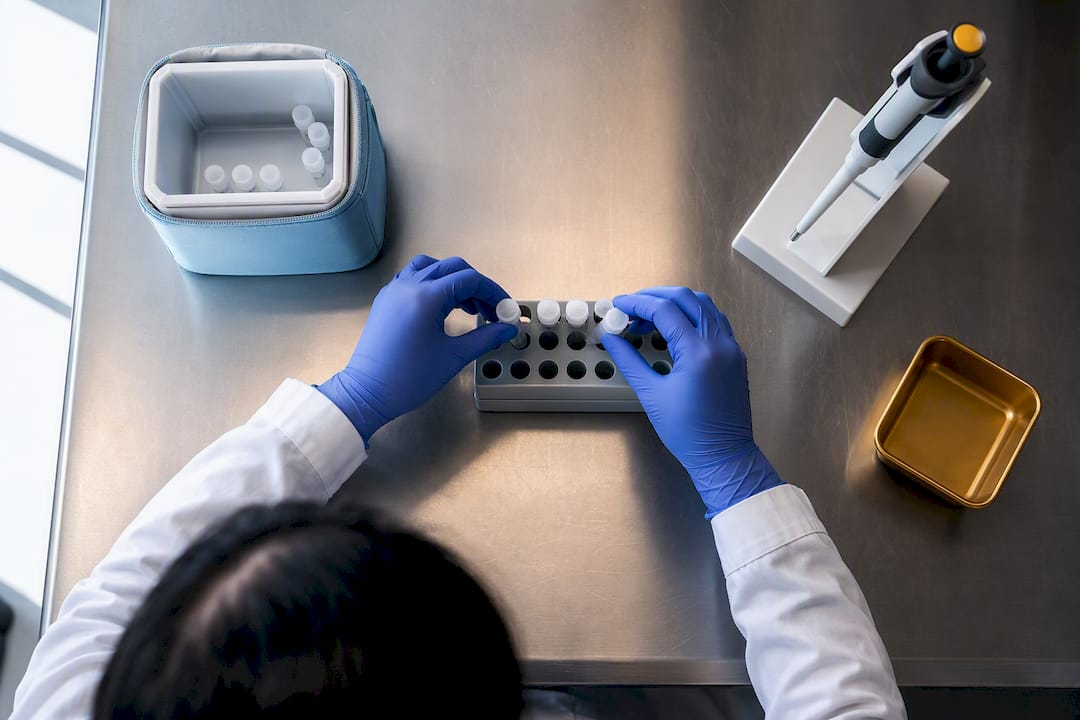
Any test you validate, whether it’s an FDA-cleared kit used off-label, a modified assay, or a homebrew method, needs documented proof of accuracy, precision, sensitivity, specificity, and reportable range before it touches a single patient specimen.
Beyond the assay itself, plan for:
- A qualified laboratory director meeting CLIA personnel standards for the complexity level you run.
- Documented QC schedules and instrument maintenance logs kept audit-ready.
- Personnel competency assessments, repeated on a defined cadence.
- Strict adherence to manufacturer instructions for any waived point-of-care test, with zero deviation.
Pro Tip: Build your validation binder before your first enrollment, not after your first audit request. Retrofitting documentation under deadline pressure is where most research-to-clinical conversions lose weeks.
Exemptions, state differences, and edge cases
The research exemption is real but narrow. It applies only when your lab performs testing purely for research purposes and does not report patient-specific results to subjects, treating clinicians, or a medical record. The moment a result influences care, UCSF’s own IRB guidance notes the exemption disappears, even if the study is federally funded and IRB-approved.
A few carve-outs and wrinkles worth flagging:
- SAMHSA-regulated drug testing and certain forensic testing programs operate under separate federal frameworks, not standard CLIA certificates.
- New York and Washington run their own state programs that CMS treats as deemed equivalents, but the requirements aren’t identical to federal CLIA.
- Some states impose additional documentation or inspection rules beyond the federal baseline.
Always confirm current rules with your State Agency before assuming a national standard applies uniformly.
Partner with a CLIA lab or build in-house?
Converting a research core into a CLIA-compliant operation is a real infrastructure project, not a paperwork exercise. Molecular labs typically need separate pre- and post-amplification workspaces, documented IQ/OQ/PQ for automated instruments, and per-assay validation studies, plus a functioning quality management system most research cores have never built.
Building makes sense when testing volume is high and ongoing, and you already have a qualified director on staff. Partnering makes more sense for single studies, multi-site trials, or programs that need to move fast without a multi-month buildout. Timelines vary sharply: waived-test conversions can close in weeks, while moderate or high complexity buildouts routinely stretch six months or longer once validation and survey scheduling are factored in.
If you evaluate a partner lab, check for:
- Active proficiency testing participation with a clean track record.
- Current accreditation status and survey history.
- Realistic turnaround time commitments, not marketing promises.
- Direct data integration with your EMR or EDC system.
- A contract model that clearly assigns regulatory ownership.
Pro Tip: Ask any prospective lab partner for their most recent PT summary report before you sign anything. A lab that hesitates to share it is telling you something.
For deeper due diligence on evaluating a regulatory compliant laboratory, a detailed checklist can save weeks of back-and-forth during vendor selection. You can also compare accreditation frameworks directly through this breakdown of AABB, CAP, and ISO 17025 standards.
How integrated CLIA-certified diagnostics accelerate research
Fragmented vendor management is one of the quiet killers of trial timelines. Sponsors juggling separate contracts for labs, imaging, and data delivery absorb delays at every handoff, and every handoff is a chance for a compliance gap to slip through.
A single-contract model that unifies lab, radiology, and data services centralizes regulatory ownership under one accountable partner instead of three. When CLIA-certified operations run alongside consistent proficiency testing and AI-driven quality checks, data deviations get flagged before they reach an analysis dataset, not after. That reduces rework, tightens safety monitoring, and gets clean, analysis-ready data bundles to sponsors faster across 100+ biomarkers and imaging modalities.
Editorial Take: Compliance Is a Timeline Decision, Not Just a Legal One
Most guidance on CLIA treats it as a checkbox, something legal or regulatory affairs handles while the science team focuses on the protocol. That framing costs research programs months. The real decision point comes far earlier, at protocol design, when a study team decides whether a biomarker feeds an eligibility criterion or a treatment-arm assignment.
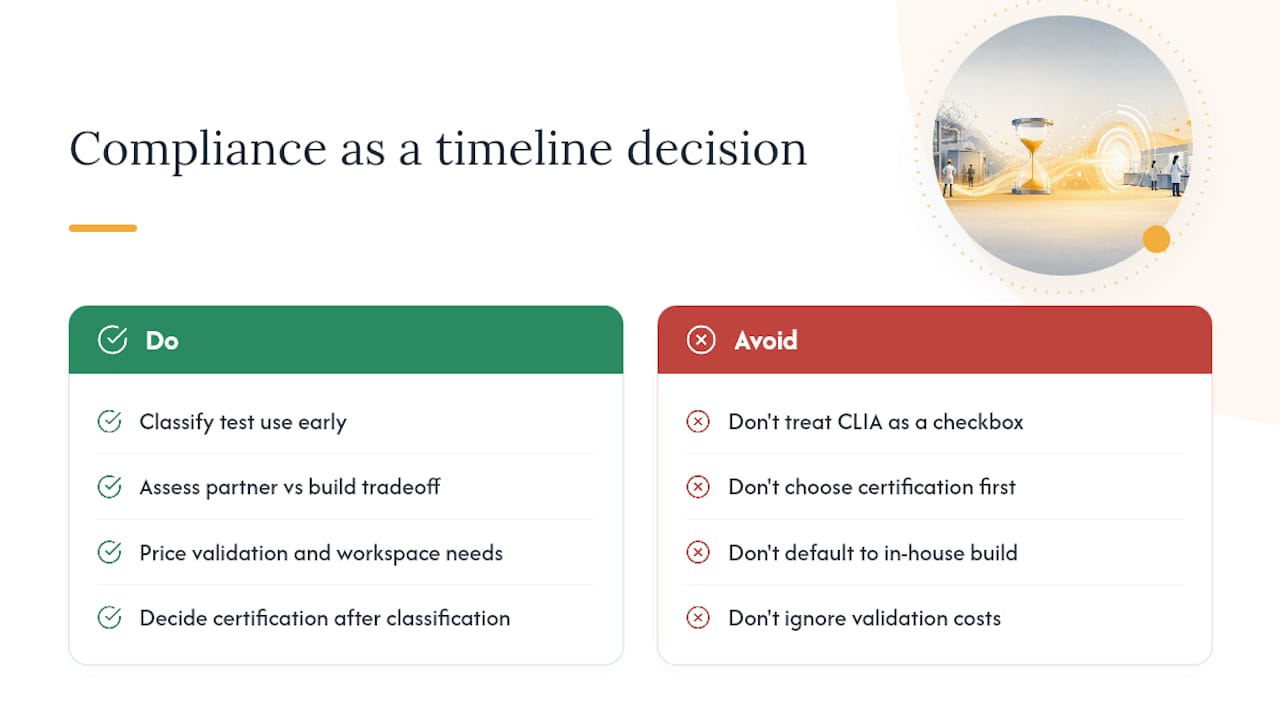
Conventional advice tends to underweight the partner-versus-build tradeoff. Teams often default to building in-house because it feels like more control, without pricing in the validation studies, dedicated workspace, and qualified director that conversion actually demands. For a single trial or a multi-site study with a defined endpoint, that math rarely favors building.
The reader’s first priority should be classification, not certification. Nail down whether results are patient-specific before choosing a certificate type or a vendor. Get that wrong, and every downstream decision, staffing, budget, and timeline, gets built on a faulty foundation.
— Kohealth Labs
How Kohealth Labs Supports CLIA-Compliant Research Testing
Kohealth Labs is the alternative to juggling separate lab, imaging, and data vendors for CLIA-regulated trial testing. Instead of stitching together three contracts and three compliance owners, sponsors and CROs get one CLIA-certified partner covering lab diagnostics, radiology, and AI-driven data delivery across more than 100 biomarkers.

Onboarding typically starts with a review of your protocol’s testing needs, followed by panel selection, EMR or EDC integration setup, and site training before the first specimen ships. Proficiency testing participation and AI quality checks run continuously in the background, catching deviations before they reach your analysis dataset rather than after a monitoring visit flags them.
If your research program needs a CLIA-certified lab partner that can also handle imaging and analysis-ready data delivery under a single contract, start with an overview of Kohealth Labs’s integrated diagnostics or explore how the single-contract model speeds up trial timelines.
Where to Verify the Rules Yourself
Regulations change, and state rules vary, so verify details directly before finalizing your compliance plan. The CDC’s CLIA program overview explains scope and the research exemption. CMS’s how-to-apply guidance walks through Form CMS-116 and fees. The FDA’s CLIA database confirms whether a specific test is waived or nonwaived. Oregon State’s research guidance and UCSF’s IRB guidance offer practical, protocol-level interpretations worth reading before you submit anything to your State Agency.