
Capture Five Chain of Custody Fields That Make CROs Audit Ready
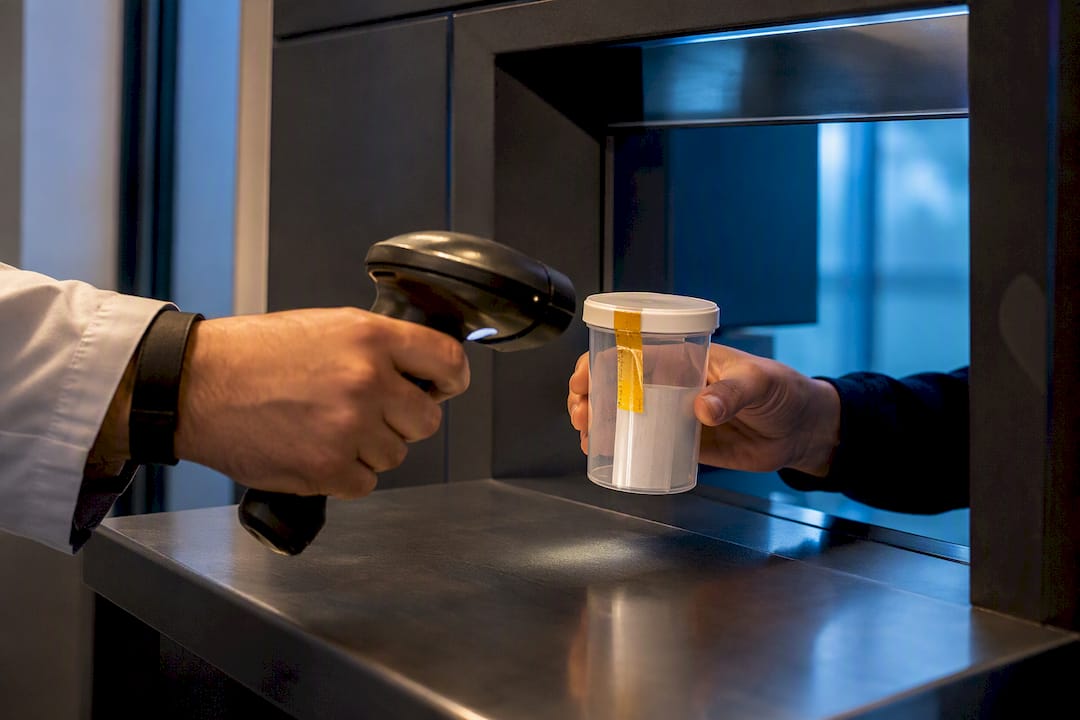
Chain of custody for clinical research samples is the documented trail proving who handled a specimen, when, and under what condition, from collection to final disposition. Every transfer must capture five items: a unique specimen ID, the named custodian, a precise timestamp, the action taken, and the specimen’s condition. This article covers custody mapping across sites and labs, SOP structure, and a ready-to-use checklist for site staff and couriers.
TL;DR:
- Unique specimen IDs must be distinct and non-colliding to prevent ambiguity during record tracing months later.
- Custodian names should be specific individuals, not departments, and timestamps require automation with a reliable time source.
- Map custody responsibilities before enrollment, assigning clear owners and systems for each event type to avoid gaps mid-study.
- Most audit failures stem from transfer points such as collection, packaging, handoff, and receipt, where complete and verified documentation is critical.
- Consolidating lab, courier, and imaging providers into a single contract reduces reconciliation points and minimizes custody documentation errors.
What Belongs in a Compliant Chain-of-Custody Record?
A defensible custody record starts with an identifier scheme that never collides. Kit IDs, sample IDs, and aliquot IDs need distinct formats so a lab tech pulling records months later can trace one tube back to one visit without guessing. Sponsors that reuse similar-looking IDs across cohorts or study arms create the exact ambiguity auditors flag first.
Every entry also needs a named custodian, not a department. “Site coordinator, Jane Rivera” holds up under review; “the lab” does not. The CASRAI research specimen guidance is explicit that tracking must persist through the full specimen lifecycle, with each transfer showing a person or an authenticated system, not a vague role.
Timestamps should auto-generate wherever possible rather than rely on handwritten entries, and every system on the chain needs a documented time source so a courier’s scan and a lab’s accessioning clock agree within minutes, not hours.
Barcode and RFID systems can serve as the custody backbone, but only when they enforce per-user authentication at each scan and block silent edits after the fact.
At each handoff, record:
- Action taken (collected, packed, received, aliquoted, destroyed)
- Condition observed (temperature, seal integrity, visible damage)
- Confirmation the packaging matched protocol requirements
Closing the loop matters as much as opening it. A sample without a documented final disposition, whether archived, transferred, or destroyed, leaves an open item an auditor will always find.
How Do You Map Custody Across Sites, Couriers, and Labs?
Multi-site trials fail custody audits most often because no one defined who owns each event. A custody map assigns an authoritative source to every step: the site owns collection and initial labeling, the courier owns transit condition, the depot owns interim storage, and the receiving or specialty lab owns accessioning and final testing.
Build the map before enrollment starts, not after the first shipment goes missing:
- List every event type your protocol generates (collection, aliquoting, freeze, ship, receive, retest).
- Assign one named owner and one system of record to each event.
- Define an identifier contract linking kit ID, sample ID, aliquot ID, shipment ID, and accession ID so any record can be traced backward or forward.
- Set acceptance criteria for each handoff and separate exception rules for what happens when those criteria aren’t met.
- Route unresolved exceptions to a standing reconciliation queue with a named reviewer, not an inbox.
When a courier’s scan disagrees with the lab’s receipt log, preserve both entries. Treat your LIMS as a reconciling system, not the final word, and correct records with visible annotations rather than overwriting the original observation.
Pro Tip: Map custody events at protocol design, not at site activation. Sponsors who define ownership before the first patient enrolls avoid the responsibility gaps that show up mid-study, when fixing them means retraining every site.
Which Regulations Govern Custody Documentation, and What Fails Audits?
U.S. trials touch several overlapping frameworks depending on the specimen and testing pathway. FDA 21 CFR Part 312 governs investigational new drug specimen handling and can trigger a clinical hold when documentation gaps raise safety or data integrity questions. CLIA applies once a specimen reaches a lab performing patient-affecting testing. DOT and IATA packaging rules govern how specimens move by ground or air, particularly for dry ice and biological substances. OSHA rules apply wherever staff handle bloodborne pathogens.
The most common triggers for findings aren’t exotic. They’re mundane:
- Missing or incomplete chain-of-custody forms at transfer points
- Labeling errors that break the identifier chain between kit and accession
- Temperature excursions during transit with no documented resolution
Custody gaps and cold-chain failures are recurring drivers behind FDA and CLIA findings, and documentation deficiencies alone can support a clinical hold under 21 CFR 312.42.
Retention windows vary by sponsor agreement, but GTEx-style SOPs recommend retaining chain-of-custody forms for a decade. Build retention into your SOP explicitly rather than defaulting to whatever your archiving vendor happens to keep.
Site and Courier Checklist: Collection Through Receipt
Most custody breaches happen at the same four points: collection, packaging, handoff, and receipt. A working checklist covers all four without requiring a training manual to interpret it.
At collection, record the subject and visit context, the kit ID, the collector’s identity, and the exact collection timestamp. A specimen labeled only with a visit number and no collector name is unverifiable the moment a discrepancy surfaces.
At packaging, follow validated triple packaging: primary container, secondary leak-proof barrier, and rigid outer shipping container. Dry ice and refrigerant quantities need to match protocol specifications, and any shipment using a data logger should have it activated before sealing, not after. Our cold chain management guide walks through validated insulated containers and logger placement in more detail, and dry ice shipping rules under UN1845 explain how to avoid carrier holds on refrigerated shipments.
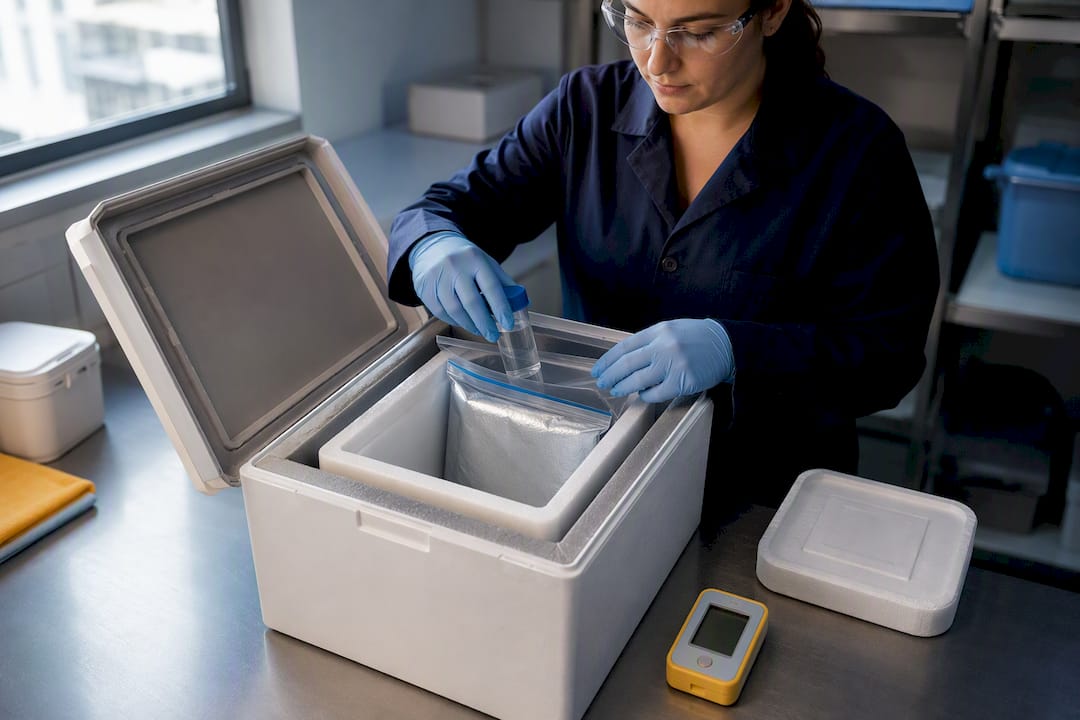
At handoff, include a paper chain-of-custody copy inside the box as a physical backup, paired with an electronic event logged to your LIMS or courier platform. Pairing paper and electronic records gives redundancy when one system fails during an audit. Require a signature or authenticated scan, never a verbal handoff.
At receipt, verify the manifest matches the shipment, inspect packaging for damage, log the temperature reading, and record acceptance or route the specimen to quarantine immediately if anything doesn’t match.
Pro Tip: Plan pickup windows and escalation contacts before site activation. Sponsors who define logistics timing and courier escalation paths early see far fewer missed pickups than teams improvising after the first shipment goes sideways.
Building SOPs That Hold Up Under Audit
A usable SOP covers six sections: purpose and scope, named responsibilities, required forms, acceptance and exception rules, retention periods, and staff training requirements. Anything missing from that list becomes the exact gap an auditor probes.
The exception workflow deserves its own attention, since it’s where most real-world custody failures actually surface:
- Quarantine the specimen immediately on any deviation, whether temperature, packaging, or documentation.
- Notify the designated acceptance owner, a specific named role who decides whether the specimen remains usable.
- Document the impact assessment: what happened, why, and what downstream effect it has on data quality.
- Target resolution as soon as possible, with the specimen held in quarantine until that resolution is documented.
Naming a real acceptance owner rather than leaving the decision to “the lab” is one of the simplest fixes that prevents custody gaps from ever reaching an inspector’s desk.
Preserve every original log entry, every correction with the approver’s name attached, every impact assessment, and every final disposition record. Auditors don’t just want the clean version. They want to see that the messy version was handled correctly, too.
Why Integrated Diagnostics Cut Custody Risk
Every vendor handoff in a trial is a place where custody documentation can break. A sponsor juggling separate contracts for labs, imaging, and courier logistics multiplies those handoff points, and each one needs its own reconciliation.
Integrated diagnostic providers that consolidate phlebotomy, courier pickup, accessioning, and radiology under a single contract reduce the number of systems that need to agree for a record to be complete. Integrated diagnostics including labs, radiology, and and data accelerates clinical trials precisely because it removes the reconciliation work that scattered vendors create.
AI-driven review can add another layer by flagging missing custody events, timestamp mismatches, or temperature excursions faster than manual audits and routing exceptions to the appropriate reviewer immediately. Faster exception resolution means fewer specimens sitting in quarantine and fewer open items when an inspector arrives. You can see how this plays out across trial workflows on our clinical trials solutions page.
— Kohealth Labs
An Integrated Path to Audit-Ready Custody Data
Chasing custody records across five vendors is where most audit findings actually start. A single-contract model that bundles phlebotomy, courier pickup, accessioning, and AI-driven data bundles into one accountable chain reduces reconciliation to one system instead of multiple vendors.

That consolidation directly reduces the regulatory exposure covered above: fewer handoffs mean fewer places for a missing timestamp or an unlogged temperature excursion to slip through. Analytics covering numerous biomarkers arrive pre-checked for deviations that typically trigger clinical holds, providing trial coordinators and sponsors with ready-to-inspect data. If your team is evaluating a partner that can absorb custody complexity instead of adding to it, visit the integrated diagnostics solutions page to see how a bundled lab and radiology contract fits your protocol.
This article is general information, not a substitute for advice from a qualified doctor. Consult a qualified healthcare professional about your own circumstances before acting on anything here.